Monday, 22 August 2011

MAGICAL DEVICE

 Omniocular used in Harry Potter

    In London, on August 21st Scientists has developed binoculars which can be pause, rewind and playback whatever we are viewing, this magical device used by the schoolboy wizard in Harry Potter.

   This digital devices are developed by the researchers at Sony which could revolutionise birdwatching, horse racing, cricket and even opera.

   In the movie Harry Potter and the Goblet of Fire, Potter uses similar magical device which was called as Omniocular which is used to watch his favourite sport of
Quidditch. The developers of new device claimed that it allows a birdwatcher to record a sighting of a rare species and then send proof to other twitchers within minutes. GPS receiver also notes the position of the sighting of the birdwatcher.

  This device will let golf and cricket spectators to enjoy their own action-replays at live tournaments or test matches. This technology also allows music fans to record and watch concerts in 3D, while recording the sound in stereo.

   Electronic giant Sony said its "vinoculars" or "video binoculars" which are the first device of their kind in the world. The conventional models which rely on two sets of lenses side by side to make distant objects appear closer, the hi-tech version captures images using two miniature cameras positioned in parallel. The captured images are displayed live on high-definition screens in the eyepieces, mimicking the look and experience of traditional binoculars.

   But at the press of a button the glasses record images either in ordinary video or in 3D, which can then be played back on a 3D television. The vinoculars can also capture still photographs, with all images and videos saved to a memory stick. Because they can record sound, birdwatchers will be able to capture birdsong and also sports fans will be able to record the reaction of spectators. And there won’t be the usual frustrating fiddle to bring an image into focus, as the vinoculars also come with electronic autofocus and “steadyshot” technology to stop images shaking even when magnified up to 20 times.

   I think this will be a useful information to all of them and it also be a magical device to all of us, similar in the movie of Harry Potter . This device will be worth and i thank to the researchers at Sony who developed.......

Saturday, 20 August 2011

MAGIC HEARTBEAT MIRROR!

Cardiocam

You can check a person's vital signs — pulse, respiration and blood pressure — manually or by attaching sensors to the body.  But a student in the Harvard-MIT Health Sciences and Technology program is working on a system that could measure these health indicators just by putting a person in front of a low-cost camera such as a laptop computer's built-in webcam. Mirrors are everyday part of our lives, but with the combination of technology, mirrors too can be taken to another level, so we’ve got a smart mirror that can analyze your heart rate.

New Technology that enables remote non-contact metabolism of viral science such as heart weight and respiration weight using a basic digital camera like a webcam. This technology provides simple and very convienient method for keeping track of your health for example, using this technology they have built a medical mirror they can measure your heart weight it is a two way mirror and there is a computer monitor built with a camera behind it so when we stand in front of the mirror the camera detects your face and starts its track over a time the video information that process to compute your viral science which is displayed back to you on in a mirror so u can imagine every day when you look in to the mirror not only see the physical appearance you also get the snap-shot of your health for physiological information.

This device that is called the Cardiocam, it is a unique device that measures your heart rate and shows it on a display in front of you. This smart mirror is designed by students from MIT Media Lab and it was shown at the SIGGRAPH interactive technology conference. As for the hardware that runs Cardiocam, a webcam is used to record the minute changes in the skin tone that happens each time when facial capillaries fill and empty with every heartbeat. After recording that, the computer will analyze your facial color change and it will display your current heart rate on the mirror itself.

But more important than the absolute number is the change. A rising heart rate indicates stress or a creeping lack of health, while a diving heart rate could indicate success at exercise.

Right now, the mirror can only read heart rate, and does not measure any other health indicators. But in the future, the bathroom mirror could easily become the centerpiece of the at  home health management system, displaying cholesterol levels while you floss and BMI while you brush your teeth.

Well, Cardiocam sounds amazing since we’ll be able to see our heart rate without using any additional devices at home and keep track of it every day, I'm pleasure to say this information. Anyhow late's hope many features in the future

WELCOME! BABY DARwin-OP

DARwin-OP
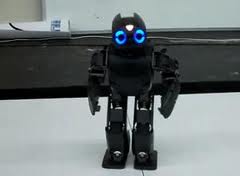
   As you know, now a days robots have advanced a lot, and now they can do all sort of things and speaking of things that robots can do, did you know that robots could dance? In real life a student from Purdue University has created a new robot called DARwIn-OP which made us to admire. As of this robot can play the game of Dance Dance Revolution, but not on its own.

  DARwIn-OP (Dynamic Anthropomorphic Robot with Intelligence–Open Platform) is an affordable, miniature-humanoid-robot platform with advanced computational power, sophisticated sensors, high payload capacity, and dynamic motion ability to enable many exciting research and education activities.

 High Performance and Advanced Features
  • - Default walking speed: 24.0 cm/sec (9.44 in/sec) 0.25 sec/step - user modifiable gait
  • - Default standing up time from ground: 2.8 sec (from facing down) and 3.9 sec (from facing up) - user modifiable speed
  • - Built-in PC: 1.6 GHz Intel Atom Z530 on-board 4GB flash SSD
  • - Management controller (CM-730): ARM CortexM3 STM32F103RE 72MHz
  • - 20 actuator modules (6 DOF leg x2+ 3 DOF arm x2 + 2 DOF neck)
  • - Actuators with durable metallic gears (DYNAMIXEL MX-28)
  • - Self-maintenance kit (easy to follow steps and instructions)
  • - Standby mode for low power consumption
  • - 3Mbps high-speed Dynamixel bus for joint control
  • - Battery (30 minutes of operations), charger, and external power adapter   (Battery can be removed from robot without shutting down by plugging in external power before removal)
  • - Versatile functionality (can accept legacy, current, and future peripherals)
  • - 3-axis gyro, 3-axis accelerometer, button x3, detection microphone x2
    DARwin-OP is a truely Open Platform, Open source Software and Open source Hardware leading that it is a PC based which can install  Windows, Offices, whatever providing languages, C++ whatever want to do, and also it is designed for research platform because has a computing platform can add more stuff for research and education. DARwin-OP has a very Efficient and Versatile Modular Configuration. It has its height of 454.5 mm (17.90 in) and its weight of  2.9kg (6.39 lb).

    Coming to its simple and clean architecture: Max 2Mbps Serial BUS and Max 3 Mbps DYNAMIXEL BUS.

    Creator of this project has designed a special pad for DARwIn-OP that allows it to move, but so far, this robot is being remotely controlled. This robot cannot keep its balance on its own, so it has to use a special bar that is placed in front of it, and due to lack of visual perception, this robot has to be remotely controlled at all times.

Wow, it is a Fantastic Robot even haven't seen anything, comparing to higher performing robot DARwin-OP is the best and i'm proud to say this information of Baby DARwin-OP!

ACTS LIKE HUMAN BRAIN?

IBM's Synapse chip
    Over the years, we all have seen how technology has improved people's lives in many ways. How technology is injected in our lives, but what if a part of us is integrated into technology?  Till now we have seen Robots doing human tasks like cleaning the house..... but what if computers could also think like humans?  Be able to asses things, adapt to situations, solve problems etc.  Its awesome, right?  Yes, and that was a idea IBM had in mind when they started the Systems of Neuromorphic Adaptive Plastic Scalable Electronics (SyNAPSE) project in November 2008.

   This was a six year long project and it has involved 100 researchers in the project.The Defense Advanced Research Projects Agency (DARPA) initially invested $4.9 million to the project, and has just added another $21 million for the production of a computer chip that functions much like the brain totally it was $41 million funding from the government's (DARPA). This neurosynaptic chip is said to require less power and will take up less space.  And there are already 2 prototypes undergoing testing.  IBM aims to arm it with 10 billion neurons and 100 trillion synapses that only consumes 1 kilowatt of power and takes up less than two liters of space.

   The chips imitate the spiking neurons and synapses of the brain through advanced algorithms and silicon circuitry.  It has  a ‘neurosynaptic core’ with integrated memory (replicated synapses), computation (replicated neurons) and communication (replicated axons).   The goal is to create a system that rewires itself as it interacts with a particular environment.
     
   “Imagine traffic lights that can integrate sights, sounds and smells and flag unsafe intersections before disaster happens or imagine cognitive co-processors that turn servers, laptops, tablets, and phones into machines that can interact better with their environments,” said Dharmendra Modha, project leader for IBM Research.
   
          IBM Researchers on Thursday unveiled a new generation of experimental computer chips "designed to emulate the brain’s abilities for perception, action and cognition." IBM said in a statement that researchers had created the basic design of the first neurosynaptic computing chip that recreated the phenomena between spiking neurons and synapses in a biological system, such as the brain.
    
    Using digital silicon circuits inspired by neurobiology, the cognitive chips contain no biological elements. The two chips, called 'core,' have successfully demonstrated simple applications like navigation, machine vision, pattern recognition, associative memory and classification.

IBM  had a press release on this thursday:
Called cognitive computers, systems built with these chips won’t be programmed the same way traditional computers are today. Rather, cognitive computers are expected to learn through experiences, find correlations, create hypotheses, and remember – and learn from – the outcomes, mimicking the brains structural and synaptic plasticity.

    The chips are the result of a multi-year initiative combining principles of nanoscience, neuroscience and supercomputing.

    Great! ...In a few years, I'll be able to get a couple of chips to replace the failing areas of our brain. This chip is creating a new dilemma, human with a robot brain or robot with a human brain.........

Friday, 19 August 2011

KEEPS YOUR LAP COOL AND LAPTOP COOLER...

                                            Welcome Lapinator Insulated Laptop Desk.


I feel happy to give information about this Lapinator Insulated Laptop Desk,  who use the laptop and get tensed after using it because of over-heat on your lap. These days there are many devices that allow you to do your computing while still being mobile, but you always end up returning to home base - that being your wireless laptop. And if you're anything like us you use your laptop computer in a variety of settings, most of them involving having the laptop, oddly enough, on your lap. The convenience is great with only one major downside - the heat. After 20 minutes your legs are roasting and it's time for a break. Enter the Lapinator. The only laptop desk that keeps your lap cool and your laptop cooler. The Lapinator uses Thinsulate™ insulation as the main barrier to the heat generated by laptop computers. This keeps your lap cool allowing you to compute in comfort. The Lapinator keeps your laptop computer cooler too! In fact, it can reduce the CPU temperature by 11 degrees more than the same laptop running on a wooden desk. The design features a rigid platform, flexible edges, compressible legs and its slim profile allows you to easily slip the Lapinator into your bag. Three rubber spacers are included and can be positioned on the Lapinator to perfectly accommodate your laptop. There is a small velcro loop on the rear of the Lapinator to help secure any dangling cables.   

    * Thinsulate™ blocks 95% of laptop heat!
    * Only 11 ounces (13 x 12 x 1 inches)
    * Keeps your Laptop cooler
    * Comfortable and Stable
    * Ergonomic - helps prevent CTS
    * Slips into your laptop bag
    * Use it anywhere!

                
            Product Specifications
                   Brand Name     :     Lapinator
                   Model number  :     SL01
                   Color                :    Black

The self-adhesive bumpers provide better ventilation and a better typing angle and the Lapinator's "legs" let body heat escape.
  • The Lapinator is the perfect laptop companion.
  • The Lapinator Plus! offers the same quality as the original Lapinator with 5 inches more working space. The 18" wide Lapinator Plus is great for those 17" notebooks or if you simply want to use an external mouse with an average sized laptop.
  • The Mousitizer Mouse Pad provides that extra space for using an external mouse with your Lapinator! Attach it to either side of the Lapinator or Lapinator Plus.
  • 30 day unconditional money back guarantee- 1 year warranty against defects.
Well, i think you are so happy with this Lapinator laptop desk, keeps your lap cool...
and your laptop cooler!